


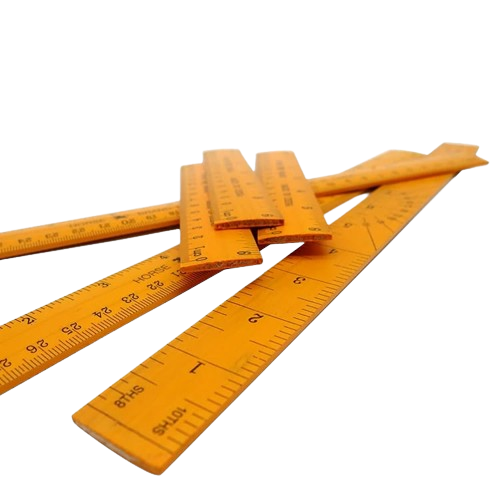
Here are some key details about meter rules:
Length: A standard meter rule is typically 1 meter (100 centimeters) long. It may have markings in centimeters (cm) along its length, with larger markings indicating every 10 centimeters (decimeter markings) and even larger markings indicating every 100 centimeters (meter markings).
Material: Meter rules are often made of wood, plastic, or metal, with wood being a traditional material and plastic being more common in modern designs.
Accuracy: The markings on a meter rule are usually accurate to within millimeters, allowing for precise measurements.
Use: Meter rules are used in various applications, including: Measuring lengths of objects, surfaces, or distances.
Drawing straight lines or marking distances in technical drawings or diagrams.
Conducting experiments in physics, engineering, and other scientific disciplines where precise measurements are needed.
Teaching and learning measurement concepts in educational settings.
Features: Some meter rules may have additional features such as beveled edges for easy reading, a hole at one end for hanging or storage, or dual scales (e.g., centimeters and inches).
Maintenance: Meter rules should be handled carefully to avoid damage to the markings or the ruler itself. Regular cleaning and storage in a dry, protected environment can help maintain their accuracy and durability.
Meter rule in Kenya.
Original price was: KSh400.KSh250Current price is: KSh250.
A meter rule, also known as a meter stick or yardstick in some countries, is a measuring tool used to measure length, distance, or dimensions.
There are no reviews yet.