
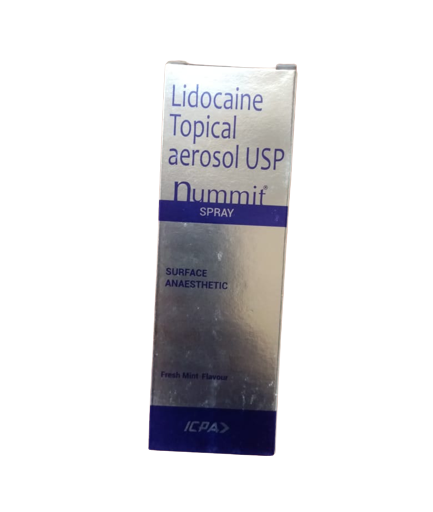
Here’s a detailed explanation of “Lidocaine Topical Aerosol USP (Nummit) Spray” — what it is, how it works, its features, precautions, and a typical step-by-step procedure for use. (Note: this is educational information and not a substitute for a doctor or pharmacist’s instructions.)
What is Nummit (Lidocaine Topical Aerosol USP)?
- Active ingredient: Lidocaine (in Nummit spray, typically 15% w/w) as a local (topical) anesthetic. Kogland+3ICPA Health Products Ltd+3OKDERMO Skin Care+3
- USP means it meets the standards of the United States Pharmacopeia for purity, strength, and quality.
- Aerosol / metered-dose spray — the formulation delivers the lidocaine in a spray form, often with propellants and inert solvents.
- Indications / Uses:
- To produce surface anesthesia / numbing of skin or mucous membranes before minor procedures (e.g. insertion of catheters, minor skin procedures)
- To reduce pain, discomfort, burning, itching from skin irritations (e.g. scrapes, insect bites, minor burns) in some settings.
- For use in some anorectal / proctologic settings (pain relief in hemorrhoids etc.)
- Onset & Duration:
- The spray is reported to absorb rapidly in 3–5 minutes, and the numbing effect may reach its maximum in 15–30 minutes.
- Duration of effect can vary (often up to a couple of hours, depending on dose, area, skin characteristics)
Key Features & Advantages
- Fast-acting: Because it is an aerosol spray, the drug can spread over the area quickly, and absorption is relatively fast.
- Metered / controlled dose: Often each “actuation” (spritz) delivers a quantified amount of lidocaine (for example, 7.5 mg per actuation is cited in one product description)
- No need for contact / spreading: Spray allows you to treat surfaces without needing to rub or touch the area (useful in painful or sensitive zones).
- Versatility: It can be used on skin or mucosal surfaces (depending on formulation and physician direction) for anesthesia, as well as for symptomatic relief of discomfort in minor skin conditions.
- Temporary effect: The numbing is reversible and localized (it does not produce general anesthesia).
- Cautions / Limitations:
- Avoid overuse or excessive area, because lidocaine can be absorbed systemically and cause toxicity.
- Should not be applied on broken, infected, or ulcerated skin unless directed.
- Avoid contact with eyes, mouth, or inhalation (accidental).
- Some people might have local reactions (redness, burning, itching) or allergic reactions.
- Use with caution in patients with heart rhythm disorders, liver disease, or other contraindications.
Step-by-Step Procedure / How to Use It
Below is a general guideline. Always follow the instructions provided by a health professional or those on the medication label, because there may be variations depending on formulation, area of application, and indication.
- Check Prescription / Label
- Confirm the concentration (e.g. 15%) and intended use.
- Read any contraindications, warnings, and instructions (for example maximum allowed number of sprays, interval between sprays, maximum treated area).
- Prepare the Area
- Cleanse the skin or mucosal surface gently (e.g. with mild soap and water), and dry it.
- If there is debris, exudate, or dirt, remove gently so the spray can contact the intended surface.
- Position the Spray
- Hold the aerosol can upright (or as directed).
- Use any extension tube (nozzle) if provided to aim the spray.
- Position the nozzle about 10–15 cm (or as specified) from the target surface.
- Apply the Spray / Actuation
- Press the button / actuator to deliver one spray (one “actuation”) aimed at the surface.
- Wait for at least 2 seconds before a subsequent spray (if more is needed) to avoid pooling.
- Limit the number of sprays as per guideline (e.g. the total dose should not exceed what is considered safe for that area/volume).
- Allow Absorption / Onset Time
- After spraying, wait for a few minutes (often 3–5 min) to allow absorption and onset of numbing effect.
- The effect may intensify over 15–30 minutes.
- Proceed with the Procedure
- Once the area is numb, the intended procedure (e.g. catheter insertion, minor incision, biopsy, etc.) may be done.
- Monitor the area for any discomfort or pain.
- After Use / Cleanup
- If there is residual spray solution (liquid), it may be gently wiped away (unless the physician wants it left on).
- Avoid covering the area with airtight dressings (unless specifically directed) because trapped anesthetic may increase absorption.
- Wash hands (unless you want to leave some numbing effect on your own skin).
- Dispose of or store the spray can as per instructions.
- Observe the area for any reactions (redness, rash, swelling).
- Reapplication (if needed)
- If more numbing is needed, additional sprays may be given — but only following the allowed frequency and total dose guidelines (e.g. respecting a 2-second gap). 1mg+2Imimg+2
- Do not exceed the maximum allowed dose or area.
Precautions, Side Effects & Warnings
- Systemic absorption & toxicity: In large doses or large surface areas, lidocaine may be absorbed systemically, which may cause CNS (e.g. dizziness, seizures) or cardiac side effects.
- Allergic reactions: Although uncommon, some people may have hypersensitivity to lidocaine (or other components).
- Local irritation: Burning, redness, itching, stinging at the site may occur (often transient)
- Avoid sensitive mucosa or open wounds unless specifically directed.
- Avoid in certain conditions: Use caution (or avoid) in patients with severe cardiac conduction abnormalities, hepatic impairment, or other contraindications.
- Avoid contact with eyes / inhalation: If sprayed accidentally into eye, rinse immediately with water and seek medical advice.
- In children, pregnancy, lactation: Use only under medical supervision; risk vs. benefit must be weighed.
- Methemoglobinemia risk: Although rare, lidocaine (and other local anesthetics) can sometimes induce methemoglobinemia, especially in vulnerable individuals (infants, G6PD deficiency, etc.).
- Avoid simultaneous use of other anesthetics or drugs that may interact (especially those affecting cardiac conduction).
- Flammability: Aerosol formulations may be flammable — avoid spraying near open flame, high heat, or sparks.
- Storage: Store in a cool, dry place away from direct sunlight, per label instructions.