


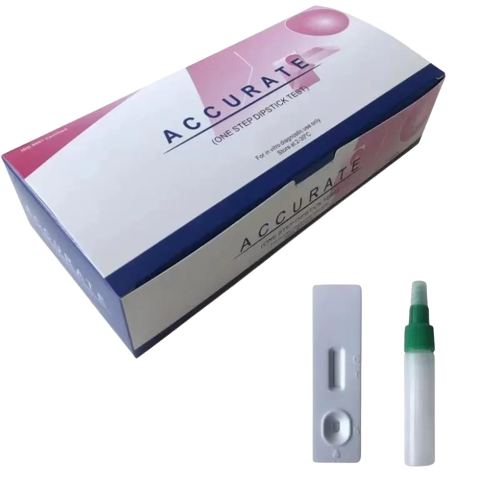
How the Test Works:
- Sample Collection: A stool sample is collected from the patient using a sterile applicator or spatula.
- Sample Preparation: Depending on the specific kit, the stool sample may need to be processed with a buffer or reagent.
- Application: The prepared sample is then applied to the test device, often using a dropper or pipette.
- Migration: The sample migrates through the device, encountering H. pylori-specific antibodies. If H. pylori antigens are present in the sample, they will bind to these antibodies.
- Result Display: A control line should always appear, indicating that the test has worked correctly. The appearance of a test line, in addition to the control line, typically indicates a positive result for H. pylori antigens. If only the control line appears, the result is negative.
Advantages:
- Speed: Results are available within minutes, making it suitable for point-of-care testing.
- Non-invasive: Since the test uses a stool sample, there’s no need for invasive procedures like endoscopy or blood draws.
- Indication of Active Infection: The test detects antigens, suggesting a current, active infection rather than past exposure.
- Ease of Use: The test can be performed with minimal training.
- Follow-up Tool: It can be used to confirm the eradication of H. pylori after treatment.
There are no reviews yet.