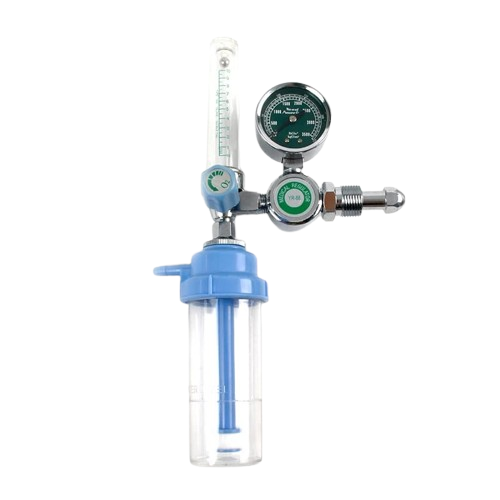
Oxygen regulator/ cylinder Flow meter kenya
(0)A flow meter is a device used to measure the flow rate or quantity of a gas or liquid moving through a pipe. Flow meters are critical in various industries and applications where precise measurements are needed for operational efficiency and safety.
In stock
SKU: oxygen-regulator-cylinder-flow-meter kenya
Categories: Theater and surgical products
Product description
Types of Flow Meters:
Different principles are used to measure fluid flow. Here are some common types:
- Differential Pressure Flow Meters: These include orifice plates, flow nozzles, and Venturi tubes. The flow rate is determined based on the pressure differential across the device.
- Positive Displacement Flow Meters: These measure the volume passed per unit time (e.g., rotary vane, piston, or gear flow meters). The fluid causes parts inside the meter to move, and each rotation corresponds to a specific volume of fluid.
- Velocity Flow Meters: Examples include turbine, electromagnetic, and ultrasonic flow meters. They measure the velocity of the fluid and use it to calculate flow rate.
- Mass Flow Meters: These measure the mass flow of a fluid directly. Coriolis and thermal mass flow meters are examples.
- Open Channel Flow Meters: Used to measure the flow rate in open channels like streams or channels, examples include weirs and flumes.
Key Considerations when selecting a Flow Meter:
- Fluid Characteristics: Understanding the nature of the fluid (viscosity, density, chemical properties) is essential because some meters might be suitable for gases but not for liquids or vice versa.
- Accuracy: Depending on the application, different levels of accuracy might be required.
- Flow Rate Range: Different flow meters operate best within certain flow rate ranges.
- Installation Requirements: Some flow meters have specific requirements related to pipe orientation, upstream and downstream straight pipe lengths, or installation depth.
- Cost: Both initial investment and long-term operating and maintenance costs should be considered.
- Temperature and Pressure Ranges: Some meters might not be suitable for high-pressure or high-temperature applications.
- Maintenance: The ease of maintenance and calibration can influence the choice of flow meter.
- Output and Connectivity: Depending on the operational requirements, the output might be analog, digital, or even compatible with specific industrial communication protocols.
Customer reviews
Not rated yet0 reviews
No reviews yet. Be the first to rate this product.
Write a review
Your email address is optional and will not be displayed.
Related products
Sale
Sale
Sale
Sale