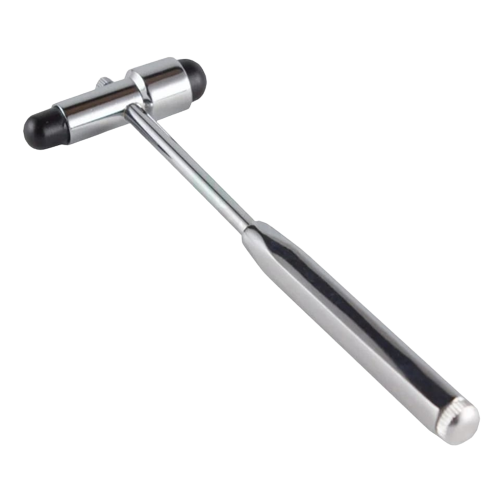
Patella hammer/Reflex hammer in kenya
(0)A patella hammer, also known as a reflex hammer, is a medical instrument used by healthcare professionals, primarily neurologists and general practitioners, to test deep tendon reflexes. Testing for reflexes is an essential part of the neurological physical examination, helping to assess the condition of the nervous system, particularly the functioning of the spinal cord and peripheral nerves.
In stock
SKU: patella-hammer-reflex-hammer in kenya
Categories: Medical Students training instruments.
Product description
Types of Reflex Hammers:
- Taylor Hammer: This is one of the most common types. It's T-shaped with a flat triangular rubber head.
- Babinski Hammer: This has an elongated, flexible handle which can be swung in a full arc. The head is usually rectangular and made of rubber.
- Tromner Hammer: It's a three-in-one design that can test both the cutaneous and myotatic reflexes. One side of the hammer has a large, soft apex, and the other side has a smaller, harder apex.
- Buck Hammer: This hammer is dual-purpose with a needle on one side and a brush on the other for cutaneous sensation testing.
Using the Reflex Hammer:
- Positioning the Patient: For the knee jerk reflex (using the patella), the patient is typically seated with knees bent and feet dangling. The healthcare professional strikes the patellar tendon just below the kneecap using the reflex hammer.
- Striking Technique: A rapid, sharp, and controlled strike is applied to the tendon. The aim isn't to hit hard but to ensure the movement is swift and sudden.
- Observation: The healthcare professional observes for a contraction of the quadriceps muscle and an extension of the lower leg, known as the knee-jerk reflex.
Interpretation:
- Normal Reflex: A swift extension of the leg is considered a normal response.
- Hyperactive Reflex: An exaggerated response might indicate certain neurological conditions, like the presence of an upper motor neuron lesion.
- Absent or Diminished Reflex: This might indicate a disruption in the reflex arc, possibly due to a lower motor neuron lesion, peripheral nerve damage, or muscle disease.
Other Uses: Besides testing the deep tendon reflexes, the reflex hammer can also be used to check for superficial reflexes, like the abdominal or plantar reflex.
Customer reviews
No reviews yet. Be the first to rate this product.
Write a review
Your email address is optional and will not be displayed.
Related products